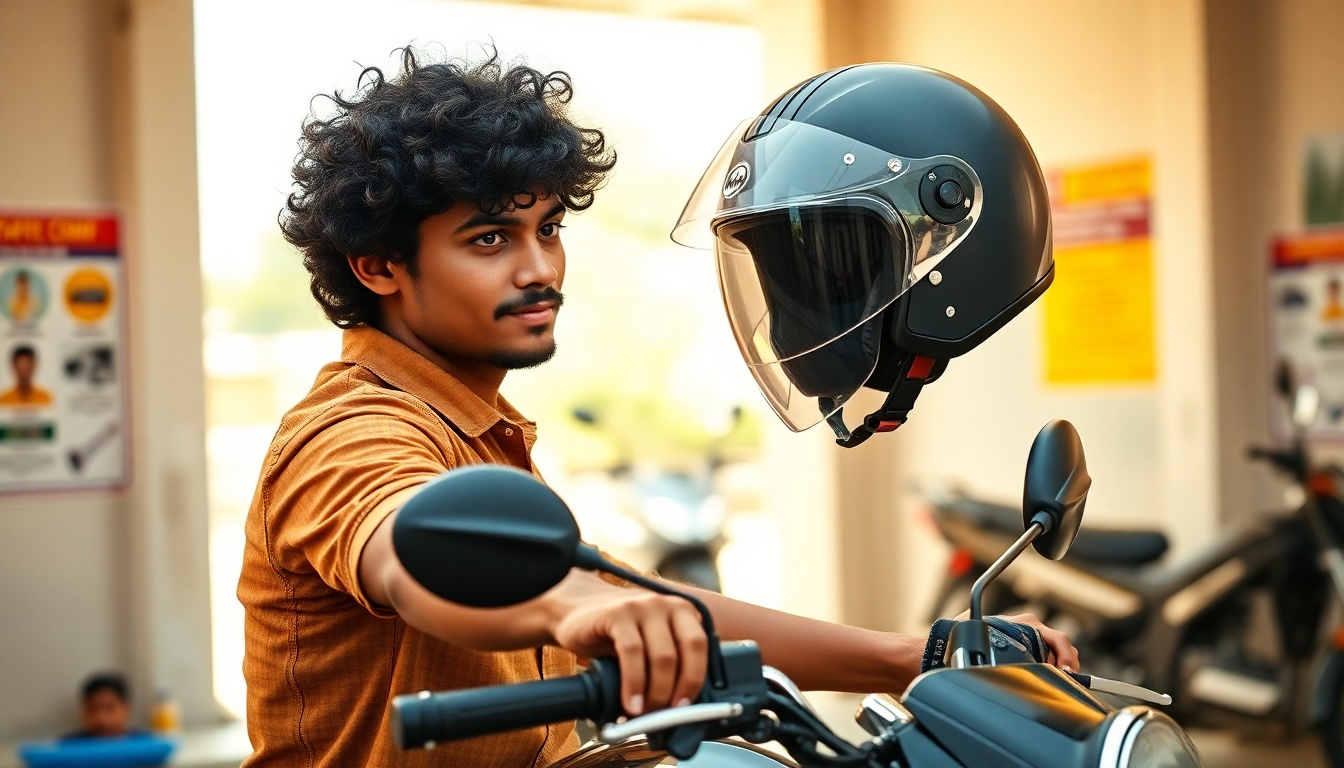
Quick Answer
Basic motorcycle training with gear is a non-negotiable first step. It’s not just about learning to balance; it’s about building muscle memory for emergency stops and swerves before you ever hit traffic. A proper 3-day course can cut your risk of a first-year crash by more than half.
I see it every weekend at our training grounds. A new rider, shiny helmet in hand, eyes wide with a mix of excitement and fear. They walk up to their first bike, a 150cc machine that suddenly looks enormous.
Their first question is never about the clutch or the brakes. It’s almost always, “Do I really need to wear this jacket? It’s so hot.” That right there is where the real lesson of basic motorcycle training with gear begins. It starts before you even start the engine.
Look, buying a bike is easy. Learning to ride it safely on our roads is a different skill altogether. And that skill is built on a foundation where the machine and your protective gear are one single unit. You cannot separate them.
Why Most Riders Get basic motorcycle training with gear Wrong
Here is what most new riders get wrong about this. They think the gear is just for the “riding” part. They put it on when they’re moving and take it off the second they stop. The real training happens when you treat the gear as part of your body from the moment you approach the bike in the parking lot.
I have seen this mistake cause close calls dozens of times. A rider practices in a t-shirt on an empty road, gets confident, and then wears a proper jacket for the first time on a highway ride. That jacket changes how your arms move. It changes your feel on the controls. Suddenly, everything feels different and stiff.
The other big error? Focusing only on the helmet. Your head is critical, yes. But on Indian roads, a low-side slide at 40 kmph will grind through denim in seconds. Your knees, elbows, and hands hit the tarmac first. Training with full gear from day one makes you accustomed to the feel, the slight restriction, the heat. You learn to move with it.
You practice your emergency stop in the gear you’ll actually crash in. There is no point learning a life-saving maneuver in shorts and flip-flops. The muscle memory won’t translate.
Last month, a student named Rohan showed up for his first session. He had already been “practicing” in his apartment basement for two weeks. He could ride in a straight line. He was proud of it.
We suited him up in our training gear—jacket, gloves, knee guards, the works. His first task was a simple figure-eight. He stalled the bike three times. “This is harder,” he said, frustrated. Exactly. The gear showed him he wasn’t in control yet. It forced him to slow down and learn the fundamentals properly. By day three, he was thanking me. The gear had stopped being a burden and started being his shield.
What Actually Works on Indian Roads
Let’s talk about what works. The real risk is not falling at high speed on a highway. It’s the unexpected grab of the front brake when a dog runs across your path in a narrow galli. Your training needs to prepare you for that exact moment.
You need to drill the “cover and squeeze” of the front brake until it’s automatic. Your gloved fingers should find the brake lever without you looking down. This is impossible to learn if you’re constantly thinking about how hot your jacket is.
Here is the thing about our traffic. It flows like water. It finds gaps. To survive, you need to be smooth and predictable. A jerky throttle input in a congested market street can put you into the side of a tempo. Gear gives you the confidence to be smooth, because you’re not terrified of a small tip-over.
I train riders to use their feet. Not for balance, but for information. Feeling the road surface through your boots tells you about gravel, oil, or water before your tires even react. Your boots are sensors. Train with them on, always.
And your eyes. A helmet visor can fog, it can get dirty. Training teaches you to clean it at a red light without fumbling. It teaches you the head check—turning your helmeted head to actually see the blind spot, not just flicking your eyes. That helmet weight matters.
Finally, gear makes you visible. A bright colored jacket or helmet in a sea of grey and black cars makes you stand out. Your training should include understanding sightlines—where other drivers can and cannot see you. The gear is part of your communication kit.
Your first bike is a tool. Your gear is the user manual for surviving mistakes with it. We don’t train you to be perfect. We train you to survive the imperfections—yours, and everyone else’s on the road.
— Throttle Angels Instructor Team
Beginner vs Trained Rider Comparison
| Aspect | What Beginners Do | What Trained Riders Do |
|---|---|---|
| Approach to Gear | See it as optional, uncomfortable equipment. Wear only a helmet, often improperly fastened. | Treat ATGATT (All The Gear, All The Time) as a non-negotiable ritual. Gear is donned before touching the bike. |
| Emergency Braking | Panic, grab a handful of front brake, lock the wheel, and fall. Or only use the rear brake and crash into the obstacle. | Progressively apply both brakes with more force on the front, body braced, eyes up. Practice this drill monthly. |
| City Traffic Filtering | Weave unpredictably, focus only on the bumper ahead, miss car doors opening and pedestrians. | Move at a controlled pace, read driver head movements, cover brakes, plan escape paths. They flow. |
| Road Surface Hazards | Hit sand, gravel, or potholes and react with a sharp jerk of the handlebar or brakes. | Spot hazards early, slow down before, keep the bike upright and relaxed, ride straight through with minimal input. |
| Mental Focus | Fixated on the vehicle immediately in front. Reactive riding. | Scanning 12 seconds ahead, monitoring intersections, mirrors, and blind spots. Proactive riding. |
Adapting to Indian Road Conditions
Book Your Trial Session Today!
Ready to master the roads of Bangalore or Pune? Join India’s premier motorcycle driving school.
Training Available in Bangalore & Pune
Book Your Trial Session Today!
Ready to master the roads of Bangalore or Pune? Join India’s premier motorcycle driving school.
Training Available in Bangalore & Pune
The monsoon is where your training and gear pay their highest dividend. Your first lesson? Those white painted road markings and manhole covers become sheets of ice when wet. A trained rider crosses them at a right angle, with neutral throttle.
On highways, the danger is fatigue and wind blast. A good jacket cuts the wind and keeps you alert. It also protects you from the bizarre things that fly off trucks—plastic sheets, pieces of rope, sometimes even bricks.
At night, your gear needs reflectivity. Stickers on your helmet and jacket can save your life. Train yourself to ride as if you are invisible, because to a tired truck driver, you often are.
Finally, the chaos of our city intersections. Your gear allows you to focus on the rickshaw cutting across three lanes, not on the fear of skin loss. You can make calm decisions because you have a layer of armor between you and the tarmac.
Frequently Asked Questions
Can’t I just learn from a friend in a parking lot?
Your friend might be a great rider, but they are not a trained instructor. They will pass on their bad habits and miss critical safety drills. A structured course builds skills in the right order, with a focus on survival from day one.
Is gear really necessary for slow-speed training?
Absolutely. Most drops happen below 15 kmph. A fractured wrist or a scraped knee from a simple tip-over can end your riding journey before it starts. Gear in training normalizes its use and protects you while you make inevitable beginner mistakes.
What is the single most important piece of gear?
After the helmet, it’s the gloves. Your instinct in a fall is to put your hands out. Road rash on your palms is debilitating and painfully slow to heal. Full-fingered riding gloves with palm sliders are a must from your very first lesson.
How much does Throttle Angels training cost?
Our courses start at competitive rates with flexible packages. Call Rajkumar at 9535350575 or Arun at 8169080740 for current pricing and batch schedules in Bangalore and Pune.
I already have a license. Do I still need basic training?
Getting a license in India often means you can operate a bike, not that you can ride it safely. If you’ve never practiced emergency braking, swerving, or slow-speed control with professional feedback, then yes, you need the training. The license is a permit; training is the skill to use it.
Look, this isn’t about scaring you. It’s about empowering you. The freedom of riding on an open highway, the thrill of a perfect corner, the joy of the journey—it’s all real and it’s all waiting for you.
But that freedom is built on respect. Respect for the machine, for the road, and for your own skin and bones. Start right. Train with gear from your very first lesson. Build the habits that will let you enjoy this for decades, not just for a few exciting weekends.
Book Your Trial Session Today!
Ready to master the roads of Bangalore or Pune? Join India’s premier motorcycle driving school.
Training Available in Bangalore & Pune