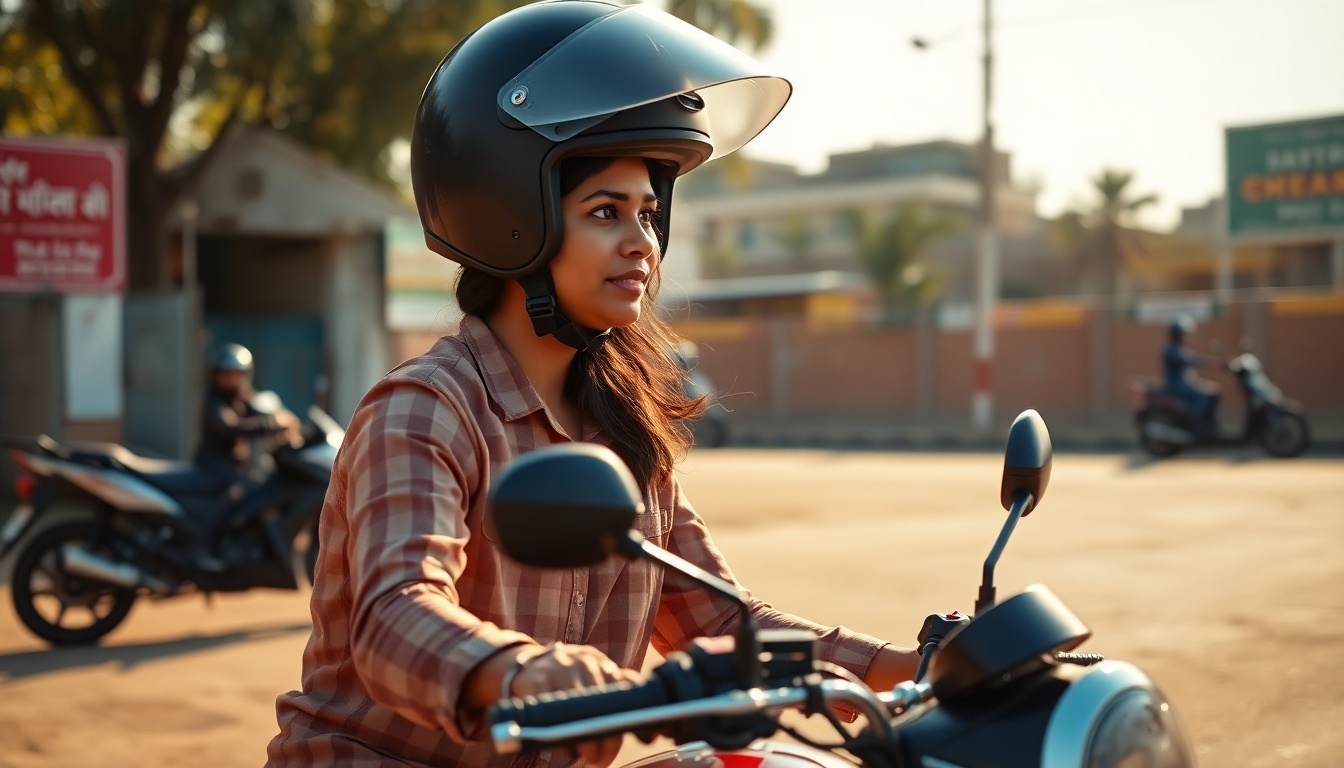
Quick Answer
A proper Royal Enfield basic riding course for beginners is a 2-3 day foundation that teaches you to manage the bike’s weight and torque, not just ride it. You need at least 15-20 hours of focused practice in a controlled environment before hitting city traffic. The goal is to build muscle memory for slow-speed control, which is where 90% of beginner drops happen.
I see it every weekend at our training grounds. A brand new Royal Enfield, gleaming in the sun, and a proud new owner standing next to it with a mix of excitement and pure fear.
They’ve just bought the bike of their dreams. But the sheer weight of a Bullet or Classic 350 feels completely different when you’re trying to turn it around in your own driveway. That’s where a structured Royal Enfield basic riding course for beginners becomes non-negotiable.
Look, these are not light motorcycles. They command respect. And the gap between wanting to ride one and actually being safe on one is what we bridge. You don’t learn this by just getting on and hoping for the best on Outer Ring Road.
Why Most Riders Get Royal Enfield basic riding course beginners Wrong
Here is what most new riders get wrong about starting on a Royal Enfield. They think it’s just a bigger bike. It’s not. It’s a different beast entirely, with a heavy flywheel and a power delivery that can surprise you.
The real risk is not high-speed wobbles. It is the slow-speed drop. I have seen this mistake cause accidents dozens of times. A rider stops at a slight angle on a gravel patch, the bike leans just a bit too much, and they don’t have the leg strength or technique to hold it up. Down goes the bike, often onto their own leg.
Another common error? Using only the front brake at low speeds. On a lighter bike, you might get away with it. On a loaded Enfield, grabbing a handful of front brake while the handlebar is turned is a guaranteed ticket to the ground. Your instinct will tell you to brake. Your training must tell you how.
Finally, riders underestimate the importance of the friction zone. That sweet spot where the clutch engages is your best friend for low-speed control, U-turns, and navigating through chaotic traffic. Without mastering it, you will be jerky, unstable, and exhausted before you even leave your colony.
I remember a student, Rohan. He had just taken delivery of his Interceptor 650. He was a confident car driver but had never ridden a motorcycle over 200cc. On his first session, he kept stalling the bike every time he tried to move off.
He was frustrated, blaming the bike. I made him sit on the stationary motorcycle, close his eyes, and just slowly release the clutch lever until he felt the bike want to creep forward. Then pull it back in. We did this for twenty minutes. The moment he felt that connection through his fingers, everything changed. His take-offs became smooth. His confidence in controlling two hundred kilograms of metal came from that one simple feeling.
What Actually Works on Indian Roads
Let’s talk about what actually works. It starts before you even crank the engine. Set up your motorcycle. Can you flat-foot at least one foot comfortably when seated? If not, you’re starting with a massive disadvantage. The seat height and suspension can often be adjusted. Do that first.
Your first hours should be in a large, empty, flat lot. Your goal is not to hit 60 km/h. Your goal is to walk the bike using the friction zone. To make a full-lock U-turn without putting a foot down. To stop smoothly on an imaginary line, every single time.
Here is the thing about braking. You must practice emergency stops until they are automatic. But on our roads, with gravel, oil, and potholes, you learn to use both brakes with a slight bias towards the rear initially. The front brake is your primary stopper, but you must apply it progressively.
Look where you want to go. This sounds trivial. But in a panic, riders stare at the obstacle they want to avoid—the pothole, the cow, the open car door. And they hit it. Your bike goes where your eyes go. Train your eyes to look for the escape path, not the problem.
Finally, practice the awkward stuff. Practice getting off the bike on the right side with the heavy kickstand. Practice pushing it backwards uphill. Practice turning it around in a narrow alley. These are the real-world skills that prevent damage to you and your prized possession.
The throttle doesn’t make you a rider. Control does. Anyone can twist a grip on an empty highway. A rider is made in the first five kilometers per hour, navigating a crowded market street with full control over every kilogram of their machine.
— Throttle Angels Instructor Team
Beginner vs Trained Rider Comparison
| Aspect | What Beginners Do | What Trained Riders Do |
|---|---|---|
| Slow Speed Control | Stiff arms, erratic throttle, feet dangling ready to dab. Prone to sudden drops. | Use the clutch’s friction zone as a throttle. Smooth, minute adjustments. Feet up on pegs. |
| Panic Braking | Grab the front brake lever hard, often with bars turned. Lock the rear wheel by stomping. | Apply progressive pressure to front brake, firm pressure to rear. Keep the bike upright. |
| Road Hazard (Pothole) | Stare at the pothole, tense up, and ride straight over it, losing control. | Eyes scan past the hazard to the clear path. Lightly rise on pegs, slight throttle, glide over. |
| Heavy Traffic Filtering | Hesitant, inconsistent speed, focus on handlebars clipping mirrors. | Smooth, predictable pace. Focus on drivers’ heads in mirrors to anticipate movement. |
| U-Turn on Narrow Street | Wide, clumsy turn, often putting a foot down or stalling mid-turn. | Head turned over shoulder, counterbalance with body, clutch in friction zone. One smooth arc. |
Adapting to Indian Road Conditions
Book Your Trial Session Today!
Ready to master the roads of Bangalore or Pune? Join India’s premier motorcycle driving school.
Training Available in Bangalore & Pune
Book Your Trial Session Today!
Ready to master the roads of Bangalore or Pune? Join India’s premier motorcycle driving school.
Training Available in Bangalore & Pune
Our roads are a living lesson in unpredictability. A Royal Enfield basic riding course for beginners here is useless if it doesn’t prepare you for monsoons. That beautiful, oily sheen on the first rain? It’s like ice. Your first ten minutes in the rain should be gentle braking and turning to scrub off that film.
Highway riding is another beast. The real danger is not your speed. It’s the crosswinds from trucks, the sudden pressure change as they pass, and the fatigue from fighting a heavy bike for hours. You learn to tuck in, relax your grip, and read the flow of traffic like a river.
And then there’s the urban jungle. Dogs, pedestrians, autorickshaws that change direction without warning. Your horn is a tool, not a weapon. A short, polite beep is a notification. A long blast is a confrontation you don’t need. Your positioning in the lane is your primary defense.
Always leave an escape route. Never ride parallel to a car’s rear door in slow traffic—that’s the “door zone.” Assume that every vehicle at a side road will pull out in front of you. This isn’t pessimism. It’s a survival strategy that keeps you and your Enfield in one piece.
Frequently Asked Questions
I have a scooter license. Is that enough for a Royal Enfield?
Legally, yes, if it’s for a bike under a certain CC. Practically, no. The weight, balance, and controls are worlds apart. A dedicated course bridges that gap between what’s legal and what’s safe.
Should I buy the bike first or do the training first?
Do the training first. We provide the training motorcycles. This way, you learn the fundamentals without the fear of dropping your brand-new bike. You make your beginner mistakes on our bikes, not yours.
How much does Throttle Angels training cost?
Our courses start at competitive rates with flexible packages. Call Rajkumar at 9535350575 or Arun at 8169080740 for current pricing and batch schedules in Bangalore and Pune.
What if I drop the training bike?
It happens. That’s why we use them. Our bikes are equipped with crash guards. We pick it up, talk about what happened, and you try again. No shouting, no extra charges. It’s part of the learning process.
Is 2-3 days really enough to learn?
It’s enough to build a solid, safe foundation. You will learn the essential controls, maneuvers, and safety drills. But riding is a lifelong skill. Consider it your first, most critical chapter. Advanced courses and constant practice come next.
Your Royal Enfield is more than transport. It’s a companion for adventures you haven’t even dreamed of yet. But that relationship needs a strong, safe foundation.
Respect the machine. Invest in your skills. The open road will still be there when you’re truly ready for it. And it will be infinitely more rewarding.
Book Your Trial Session Today!
Ready to master the roads of Bangalore or Pune? Join India’s premier motorcycle driving school.
Training Available in Bangalore & Pune