Quick Answer
Proper motorcycle training is not about passing a test. It’s about building muscle memory for survival. A good course takes at least 15 hours of focused practice, with 70% of that time spent on slow-speed control and emergency braking. That’s what keeps you safe when a car swerves into your lane.
I see it every weekend at our training grounds. A new rider, excited and a bit nervous, sits on a bike for the first time. Their eyes are fixed on the handlebar, their shoulders are tight. They think motorcycle training is about learning to go fast.
They are wrong. The first lesson is always about learning to stop. Look, your right hand knows how to twist the throttle instinctively. But teaching your fingers to squeeze the front brake progressively, while your foot stamps on the rear, that takes work. That’s where real motorcycle training begins.
It’s the difference between hitting a stray dog on a Goa highway and swerving safely around it. It’s the gap between dropping your bike in Bangalore traffic and keeping it upright. This isn’t just instruction. It’s building a library of reflexes for the chaos of our roads.
Why Most Riders Get Motorcycle training Wrong
Here is what most new riders get wrong about training. They believe it’s a one-time event. You do a weekend course, get a certificate, and you’re “trained.” That’s a dangerous way to think. Riding skill is a perishable thing. If you don’t practice the drills, you lose them.
The second big mistake is focusing on the wrong skills. Everyone wants to learn how to lean into corners. I get it, it looks cool. But the real risk is not taking a turn too slow. It’s losing control at 25 kmph when an auto-rickshaw stops without warning.
I have seen this mistake cause accidents dozens of times. A rider panics, grabs a fistful of front brake, and the bike slides out from under them. They never practiced that specific panic reaction in a safe place. Their training was theoretical, not physical.
Finally, riders train for the test track, not for Indian roads. Cones in a parking lot are predictable. A pothole hidden by monsoon water, a cow deciding to lie down in your lane, a bus driver changing his mind—these are not. Your training must account for the unpredictable.
Last month, a software engineer came to us. He’d been riding for two years, commuting in Pune. He told me, “I know how to ride, I just want to learn advanced cornering.” I asked him to show me his basic braking. He rode at 40 kmph and I yelled “STOP!”
He skidded, fishtailed, and nearly dropped the bike. His face went white. He was using only his rear brake, stomping on it. He had never, in two years, practiced a real emergency stop. That day, we didn’t talk about cornering. We spent four hours on braking drills alone. He realized his daily commute was a gamble.
What Actually Works on Indian Roads
Let’s talk about what works. First, you need to rewire your brain’s panic response. When something goes wrong, your body will default to what it has practiced the most. If you’ve only ever gently squeezed the brake, you’ll gently squeeze it in an emergency. That’s not enough.
You must practice the hard stop. Over and over. Until applying full, controlled braking force feels normal. Your brain needs to know that the bike can handle it, and more importantly, that you can.
Here is the thing about slow speed. If you can master balance and control at walking pace, everything else gets easier. Weaving through standstill traffic, making a U-turn on a narrow street, keeping the bike up when your foot slips on oil—it all comes from slow-speed confidence.
Your eyes are your best tool. Most riders look at the bumper of the car in front of them. That gives you maybe two seconds to react. You need to look through the car’s windows. See the traffic ahead of it. Scan the gaps at intersections for scooters about to jump the light.
You are not just riding your bike. You are reading the road. The body language of a pedestrian, the wandering front wheel of a cycle, the driver looking at his phone. This is not paranoia. This is building a real-time safety margin.
Finally, work on your exits. Not just your stops. When you are at a junction, your throttle control should be smooth. A jerky start can upset the bike, or worse, send you into the path of someone you didn’t see. Smooth is fast. Smooth is safe.
The certificate doesn’t save you. The muscle memory does. We’re not teaching you to pass a test. We’re drilling the reactions that become the difference between a scary story and a hospital visit.
— Throttle Angels Instructor Team
Beginner vs Trained Rider Comparison
| Aspect | What Beginners Do | What Trained Riders Do |
|---|---|---|
| Emergency Braking | Stomp on the rear brake only, causing a skid or slide. | Apply progressive front brake pressure while modulating the rear, stopping straight and short. |
| Hazard Scanning | Tunnel vision on the vehicle directly ahead. | Constant 12-second scan ahead, checking mirrors, and monitoring side gaps. |
| Slow-Speed Control | Stiff arms, erratic clutch/throttle, feet dangling for balance. | Relaxed grip, feathering the clutch and rear brake, head up looking where they want to go. |
| Cornering Approach | Brake mid-corner when they feel they’re going too fast. | All braking is done before the turn, then maintain or add gentle throttle through it. |
| Mindset | “I need to get there.” Focused on destination. | “I need to get there safely.” Focused on the journey and its risks. |
Adapting to Indian Road Conditions
Book Your Trial Session Today!
Ready to master the roads of Bangalore or Pune? Join India’s premier motorcycle driving school.
Training Available in Bangalore & Pune
Book Your Trial Session Today!
Ready to master the roads of Bangalore or Pune? Join India’s premier motorcycle driving school.
Training Available in Bangalore & Pune
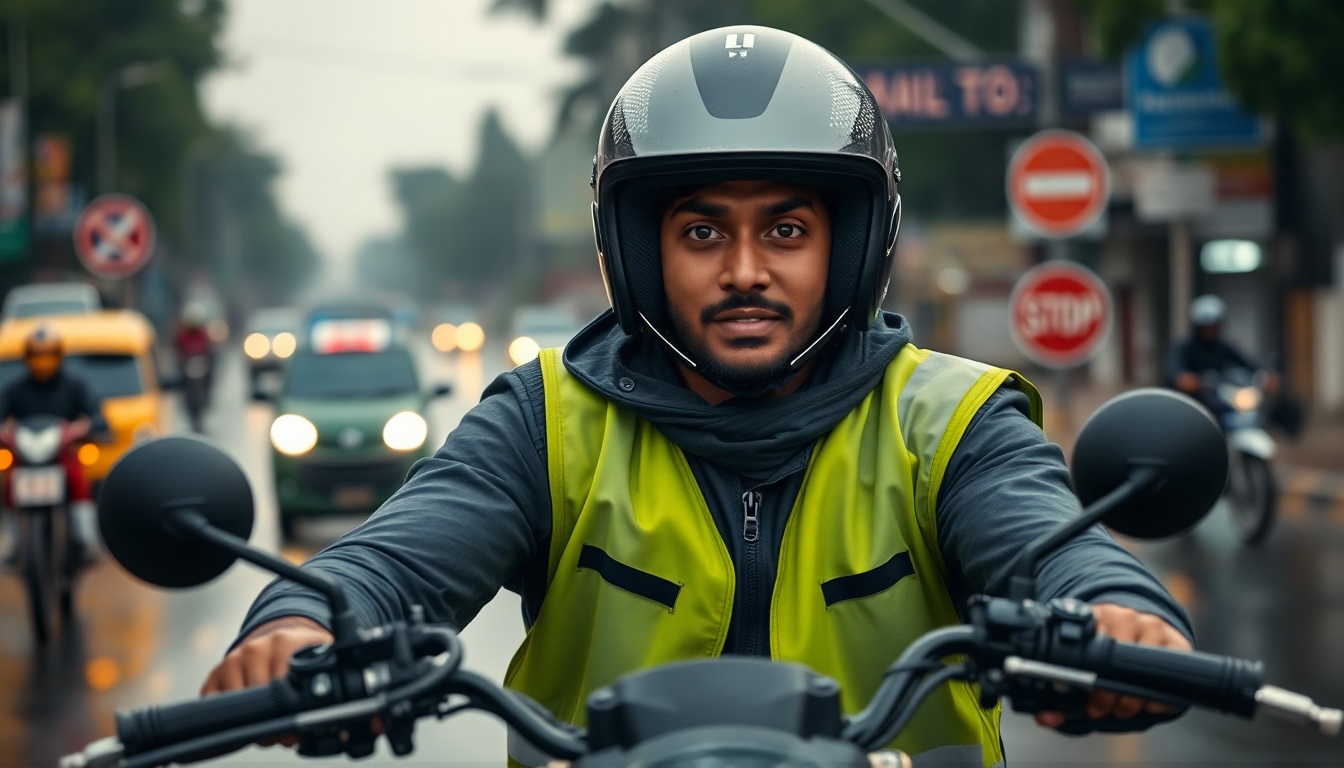
Our roads are a special kind of classroom. You have to train for conditions you won’t find in any manual. Let’s start with the monsoon. Your braking distance doubles. Maybe triples on those painted road markings and metal manhole covers.
You need to practice gentle control inputs in the wet. Find an empty, wet parking lot and feel how the bike responds. Know that a sudden lean or brake on a white line is an invitation to fall.
Then there’s the highway. The real danger isn’t high speed. It’s fatigue and target fixation. You stare at the back of a truck for ten minutes, your brain goes numb. You must actively scan, change your lane position slightly, and take breaks every hour.
Finally, the city chaos. Your lane position is your shield. Don’t ride in the center of the lane where oil and coolant accumulate. Don’t hug the curb where pedestrians step out. Ride where you are most visible and have an escape route. Always have an exit plan.
Frequently Asked Questions
I already have a license. Do I still need training?
A license proves you know the rules of the road. Training proves you can control the motorcycle under pressure. They are completely different things. Most of our students already have a license but realize they lack critical control skills.
What’s the single most important skill I’ll learn?
Emergency braking. Without a doubt. Being able to stop quickly and in a straight line avoids more accidents than any other skill. It’s the foundation everything else is built on.
Should I use my own bike or yours for training?
Start with ours. You will drop it. Everyone does when they’re pushing limits in a safe space. It’s part of the learning. Once the core skills are built, we strongly advise practicing the same drills on your own bike to build familiarity.
How much does Throttle Angels training cost?
Our courses start at competitive rates with flexible packages. Call Rajkumar at 9535350575 or Arun at 8169080740 for current pricing and batch schedules in Bangalore and Pune.
Is one course enough, or should I come back?
One course gives you the tools. But skills rust. We recommend a refresher every year or two, or before a big tour. Think of it like a gym membership for your riding reflexes. You need to keep them strong.
Look, this isn’t about making you a perfect rider. There’s no such thing. It’s about making you a prepared rider. The roads will always throw surprises at you.
Your goal is to have an answer for those surprises, stored in your hands and feet. Start with the basics. Master the stop. The rest of the ride gets a whole lot more enjoyable, and a whole lot longer.
Book Your Trial Session Today!
Ready to master the roads of Bangalore or Pune? Join India’s premier motorcycle driving school.
Training Available in Bangalore & Pune