Quick Answer
Advanced hazard anticipation riding is about reading the road 12-15 seconds ahead, not just the vehicle in front of you. It means predicting the unpredictable, like a pedestrian suddenly crossing or a car door swinging open. On Indian roads, this skill is your primary safety net, turning potential collisions into smooth, controlled adjustments.
I was on the Mysore highway last week, trailing a student. We were in a nice, staggered formation, cruising at a safe speed.
Ahead, a bus was stopped on the left shoulder. My student saw the bus. He saw the stationary traffic. What he didn’t see was the three schoolkids about to sprint across the road from behind the bus. I did. Because I wasn’t looking at the bus. I was looking at the shadows under it, the gap between its tires.
That is the core of advanced hazard anticipation riding. It’s not about reacting to what you see. It’s about predicting what you can’t see yet. Your eyes stop being passive cameras and become active radar systems.
Why Most Riders Get advanced hazard anticipation riding Wrong
Here is what most new riders get wrong about hazard anticipation. They think it’s about keeping a “safe distance.” That’s just the start. The real risk is not the car ahead of you. It’s the blind spot you haven’t identified yet.
I have seen this mistake cause near-misses dozens of times. You’re filtering through traffic in Bangalore, focused on the gap between two cars. You’re watching their brake lights. But you’re not watching the driver’s head. Is he looking at his phone? Is her head turned, talking to a passenger? That split-second glance away is your hazard. It means that car could drift into your lane without any signal.
Another common error is target fixation. You see a pothole or debris, and you stare at it. Your brain tells your hands to go where you’re looking. So you hit the thing you were trying to avoid. The anticipation failed because you locked onto the problem instead of the solution—the clear path around it.
Look, anticipation is tiring. It requires constant mental processing. Most riders do it for five minutes after a scare, then go back to autopilot. On our roads, autopilot is a one-way ticket to the emergency room.
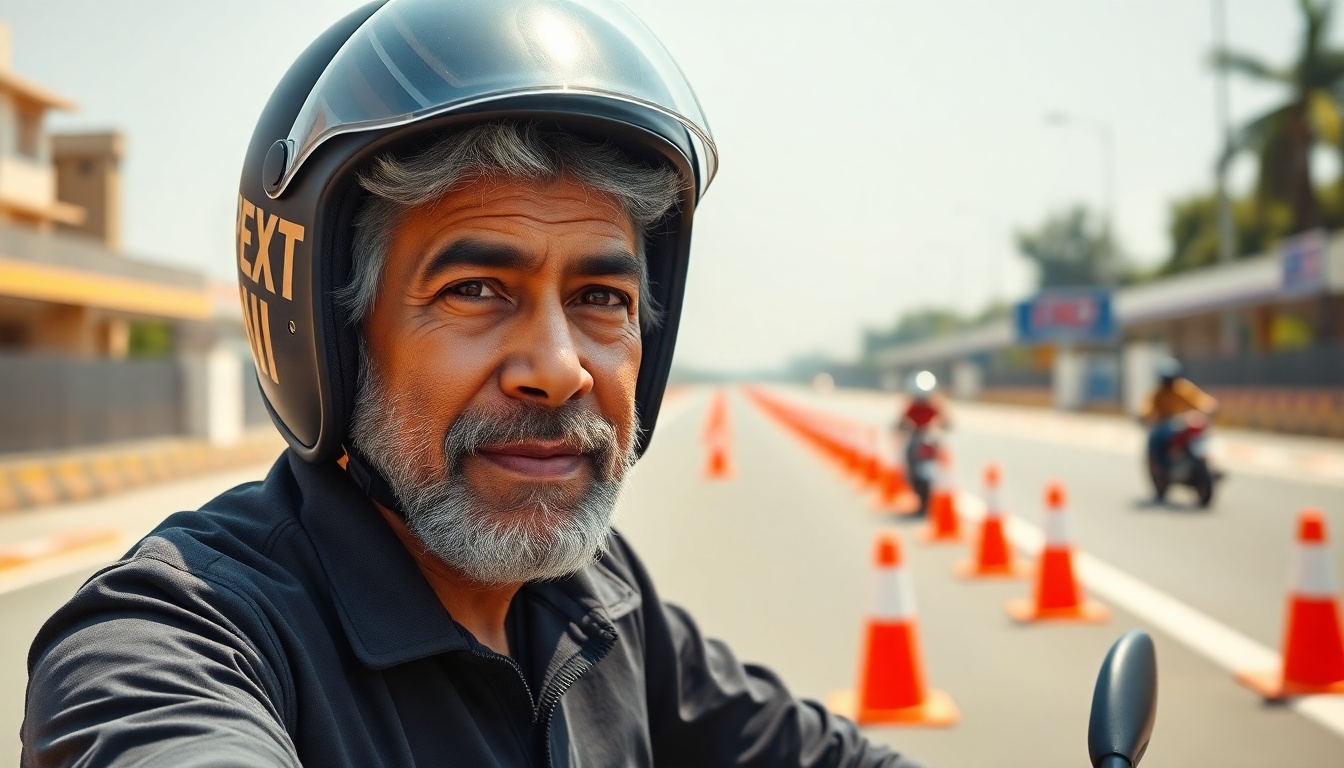
I remember a student, a seasoned tourer who had ridden across Ladakh. He came to our Pune track for an advanced session. Confident guy. I asked him to follow me on a simulated city ride through our cone course.
I’d set up a scenario: a “car” (a cone with a board) parked near a “school zone” sign. As we approached, I tapped my brake lightly, then swerved gently left. He just slowed down, staying in his lane. Right where I’d placed a dummy cardboard “child” that rolled out from behind the car. He missed it by inches. He stopped, took off his helmet, and his face was white. “I never saw it coming,” he said. He learned that day that experience doesn’t equal anticipation. You have to drill the pattern of thought until it’s instinct.
What Actually Works on Indian Roads
Here is the thing about our traffic. It follows a chaotic logic. Your job is to learn that logic. Start with your vision. You must practice a hard, sweeping scan. Don’t just look 10 feet ahead. Look at the intersection 100 meters away.
What is happening there? Is the signal green? Are vehicles starting to move? That tells you if the car next to you might suddenly brake or swerve. Look at the sides of the road. Shop fronts, bus stops, tea stalls. People congregate there, and they will step onto the road without a glance.
Watch the wheels of vehicles, not just the bodies. A wheel beginning to turn is the first and truest signal of a vehicle’s intent. A car door might swing open, but the front wheel turning out is your five-star warning.
Create escape routes. Always. In flowing traffic, position yourself so you have an “out”—a gap to your left or right you can move into if the space in front of you vanishes. This isn’t paranoia. It’s a plan.
The real risk is not the obvious hazard. It is the second or third event that follows. That cow on the highway median is hazard one. Hazard two is the truck behind you that panic-brakes. Hazard three is the speeding SUV behind the truck that doesn’t brake at all. You anticipated the cow, so you should have already checked your mirrors and planned your buffer.
Finally, communicate. Use your horn not as a shout, but as a polite “I am here.” A short beep when you’re in a blind spot, when filtering past a car that looks occupied. Make eye contact with drivers at junctions if you can. If you can’t see their eyes, assume they haven’t seen you.
Anticipation isn’t a skill you add to your riding. It’s the foundation you build your riding upon. The bike controls are just your tools. Your eyes and your brain running scenarios are what keep you alive.
— Throttle Angels Instructor Team
Beginner vs Trained Rider Comparison
| Aspect | What Beginners Do | What Trained Riders Do |
|---|---|---|
| Scanning Pattern | Focus on the vehicle immediately ahead. Reactive vision. | Systematic scan: far ahead, mid-range, mirrors, repeat every 5-7 seconds. |
| Reading Intersections | Watch the traffic signal. Proceed on green. | Watch the wheels and body language of cross-traffic vehicles, expecting red-light runners. |
| Positioning Near Parked Cars | Ride close to them, focusing on the moving lane. | Give a full door’s width of space. Look for shadows under cars, signs of occupancy. |
| Approaching Blind Curves | Stay in the center, maintain speed. | Move to the outside of the curve for a better sightline, cover brakes, reduce speed. |
| Following Large Vehicles | Stay directly behind, using it as a wind shield. | Stay offset to see past it, or overtake safely. Never sit in its absolute blind spot. |
Adapting to Indian Road Conditions
Book Your Trial Session Today!
Ready to master the roads of Bangalore or Pune? Join India’s premier motorcycle driving school.
Training Available in Bangalore & Pune
Book Your Trial Session Today!
Ready to master the roads of Bangalore or Pune? Join India’s premier motorcycle driving school.
Training Available in Bangalore & Pune
Monsoon riding changes everything. Your primary hazard is not the water on the road. It’s the hidden pothole beneath it, or the diesel spill it’s hiding. You must read the texture of the water. A smooth, glassy patch on a tarmac road often means something is mixed in—oil, coolant. A jagged, broken surface means a pothole.
On highways, watch for “sleep zones.” Those long, straight stretches after a toll booth are where truck drivers doze off. You’ll see the vehicle begin a slow, lazy drift across lane markings. Spot it early. Give a long, clear horn from a safe distance. Be ready to escape.
In city chaos, the biggest threat is the “multiple threat” scenario. A rickshaw stopping suddenly, a pedestrian darting from the right to catch it, and a scooter trying to overtake you on the left all at once. Your anticipation must be layered. Solve the first problem in a way that doesn’t put you in the path of the second.
Festival days, school timings, market areas—these are not just background noise. They are critical data. Your brain should register “school zone = 3:30 PM = children running, parents on phones, chaotic parking.” Adjust your speed and alertness before you even see the first child.
Frequently Asked Questions
How do I practice hazard anticipation without getting overwhelmed?
Start with one thing per ride. Today, just practice looking at the wheels of every vehicle near you. Tomorrow, practice identifying a single escape route at all times. Break it down. Your brain will start compiling these skills into a seamless process.
Is advanced anticipation only for highway riding?
Absolutely not. It’s most critical in city traffic where hazards are layered and unpredictable. Highways give you more time to react, but city streets demand you see hazards before they fully form.
Can I learn this from videos, or do I need on-bike training?
Videos build theory. On-bike training builds instinct. In our courses, we create controlled scenarios that mimic real chaos. You get to make mistakes in a safe environment, with an instructor pointing out what you missed. That feedback is priceless.
How much does Throttle Angels training cost?
Our courses start at competitive rates with flexible packages. Call Rajkumar at 9535350575 or Arun at 8169080740 for current pricing and batch schedules in Bangalore and Pune.
What’s the single most important habit to develop first?
The 12-second scan. Force your eyes to look as far down the road as you will travel in the next 12 seconds. This simple shift pulls your attention away from immediate distractions and opens up your visual field to developing dangers.
Look, this isn’t about making you a nervous rider. It’s the opposite. True confidence comes from knowing you have a plan. You’ve seen the movie before. You know how the scene might play out.
Your next ride, try it. Just pick one thing from this page. Watch the wheels, scan further ahead, find your escape route. Feel the difference. That small moment of calm in the chaos is what we train for. It’s what keeps you riding another day, another year, another thousand kilometers.
Book Your Trial Session Today!
Ready to master the roads of Bangalore or Pune? Join India’s premier motorcycle driving school.
Training Available in Bangalore & Pune