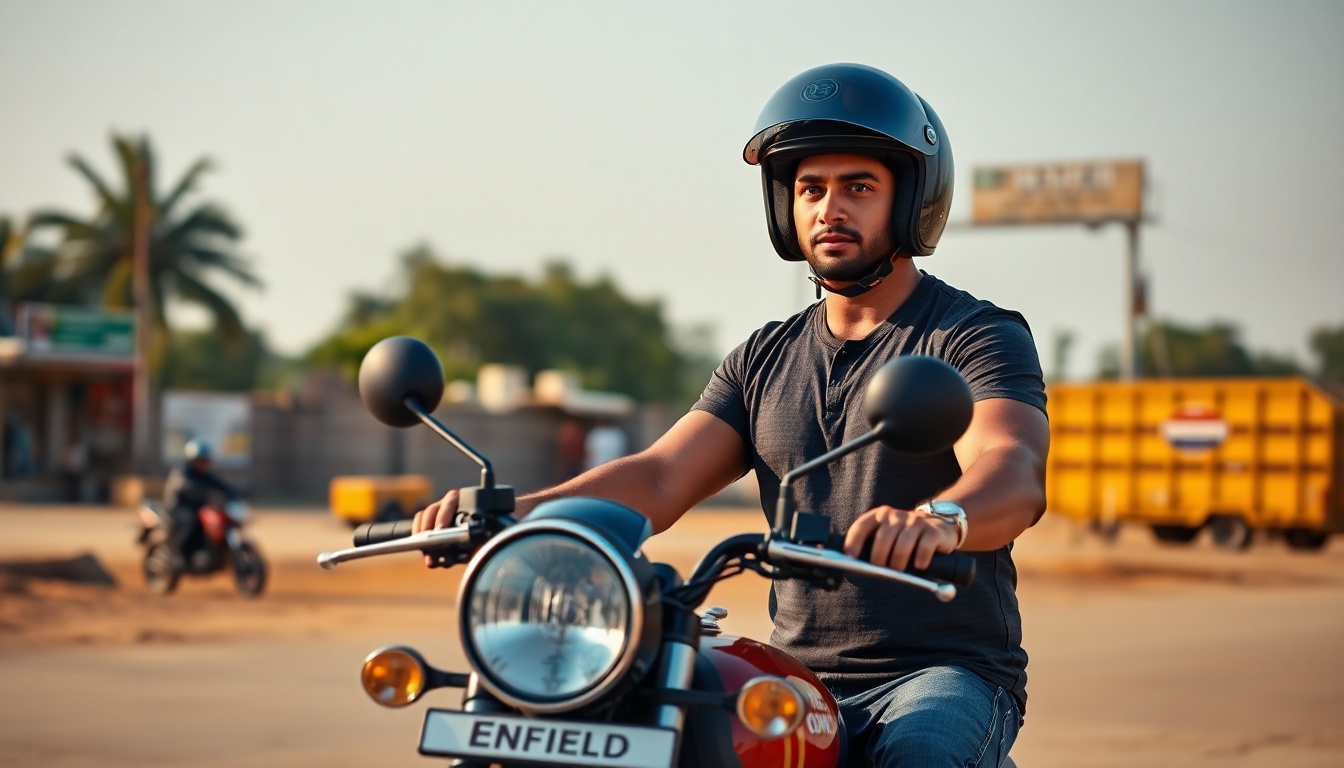
Quick Answer
Yes, you absolutely need structured beginner motorcycle training for a Royal Enfield. The bike’s weight and torque demand specific skills most new riders don’t have. A proper 3-day course can teach you the clutch control, low-speed balance, and emergency braking techniques that will keep you safe on your first 500 kilometers.
I see it every weekend at our training grounds. A proud new owner walks up to their gleaming Royal Enfield, heart full of dreams of open highways. They fire up that thumping engine, and for a moment, everything is perfect.
Then they try to move. The bike lurches. A foot goes down in panic. That beautiful machine suddenly feels like a 200-kilogram metal elephant they have to wrestle. This is the exact moment beginner motorcycle training for Royal Enfield becomes non-negotiable.
You bought the bike for the feeling of freedom, not fear. But here is the thing about these motorcycles—they reward respect with endless joy and punish overconfidence instantly. The training isn’t about learning to ride. It’s about learning to manage mass and momentum, two things a Royal Enfield has in abundance.
Why Most Riders Get beginner motorcycle training Royal Enfield Wrong
The biggest mistake is thinking you already know how to ride. Maybe you’ve handled a 150cc commuter bike for years. You think the principles are the same, just scaled up. They are not.
On a light bike, you can get away with sloppy clutch work and last-minute braking. On a Bullet or a Classic 350, that sloppiness translates into a stalled engine in the middle of a chaotic Bangalore intersection, or a rear wheel lock-up on a wet Pune road. The real risk isn’t high-speed wobbles. It’s low-speed drops and urban panic.
Another common error is focusing only on the “riding” part. You practice going straight, maybe taking a few turns. But what about when you need to park on a slight incline? Or when an auto-rickshaw cuts you off and you must stop now with your front wheel turned slightly?
I have seen this mistake cause accidents dozens of times. A rider stops, puts their foot down, but the bike is leaning just a bit too much. The weight takes over. Down it goes, often taking your ankle or your pride with it. Training teaches you how to set up every stop so the bike’s weight works for you, not against you.
A student named Arjun showed up last month with a brand-new Meteor 350. He was a confident guy, used to riding a scooter in Mumbai traffic. On his first slow-speed U-turn drill, he target-fixated on the cone he was trying to avoid.
He stared right at it, and like magic, the bike went straight for it. He grabbed a handful of front brake while the handlebar was turned. The bike tipped. He caught it, but just barely, muscles straining. That moment of fear was his best teacher. We spent the next hour just on where to look. By the end, he was making smooth, controlled circles, his eyes always up and ahead, not down at the danger. The bike felt lighter because his brain was finally in control.
What Actually Works on Indian Roads
Look, the manual won’t teach you this. You need to develop something I call “weight sense.” It’s a physical understanding of where the bike’s center of gravity is at any given moment. You build this through deliberate, slow practice.
Start with your feet up and walking the bike. Feel how it wants to fall to one side if it’s not perfectly upright. Now, use the clutch and a tiny bit of throttle to creep forward at walking pace, with your feet still on the pegs. This is your most important skill for Indian traffic jams.
Here is what most new riders get wrong about braking. They use the rear brake too much because they’re scared of the front. On a heavy bike, the front brake is your best friend. It does 70% of the work. You must learn to apply it progressively, squeezing, not grabbing.
Practice this in a clean, empty lot. Ride at 30 km/h, look straight ahead, and practice bringing the bike to a smooth, firm stop using both brakes together. The goal is to stop so smoothly a passenger wouldn’t spill their chai. This muscle memory will save you when a car door swings open.
Cornering is another reality check. You don’t flick a Royal Enfield into a bend. You place it. You set your speed before the turn, look through the corner, and let the bike follow your gaze. Trying to correct mid-corner with a heavy bike is a fight you will lose.
Finally, practice the pickup. Know how you will lift this bike if it falls over on a lonely road. The technique is everything—back to the bike, legs doing the work, not your back. We drill this because it’s not a matter of if you’ll need it, but when.
Your right wrist and your left hand are in a constant conversation. The throttle says ‘go,’ the clutch says ‘how smoothly?’ Master that conversation, and the bike stops being a beast and starts being your partner.
— Throttle Angels Instructor Team
Beginner vs Trained Rider Comparison
| Aspect | What Beginners Do | What Trained Riders Do |
|---|---|---|
| Low-Speed Control | Feet constantly dab the ground. Jerky, nervous clutch releases causing stalls or lurches. | Feet stay on pegs. Use precise clutch friction zone and rear brake to crawl smoothly through traffic. |
| Emergency Stop | Panic, slam the rear brake only. Bike skids or doesn’t stop in time. | Instantly apply progressive front brake with supportive rear. Bike stops straight and in control. |
| Handling a Drop | Try to muscle it up with their back, often failing or causing injury. | Use the correct leg-lift technique. Retrieve the bike safely in under 30 seconds. |
| Cornering Approach | Enter too fast, brake mid-corner, fight the handlebars to stay on line. | Slow before the turn, look where they want to go, maintain steady throttle through the arc. |
| Mental Focus | Fixed on immediate threats (pothole, cow). Reactive riding. | Scans 12 seconds ahead. Plans escape routes. Predictive riding. |
Adapting to Indian Road Conditions
Book Your Trial Session Today!
Ready to master the roads of Bangalore or Pune? Join India’s premier motorcycle driving school.
Training Available in Bangalore & Pune
Book Your Trial Session Today!
Ready to master the roads of Bangalore or Pune? Join India’s premier motorcycle driving school.
Training Available in Bangalore & Pune
Our roads are a special kind of classroom. You have to read the surface like a book. That dark patch ahead isn’t water, it’s diesel spill. That smooth-looking patch in the rain is polished tar, slick as ice.
In monsoon, your biggest enemy is the first hour of rain. That’s when all the oil and grime rises to the surface. Give yourself triple the stopping distance. And never ride through a waterlogged section you can’t see the bottom of. A submerged pothole can bend a wheel or throw you off.
On highways, the wind blast from trucks is a real force. When overtaking a heavy vehicle on a Royal Enfield, you need a firm grip and a positive throttle input. Don’t linger in the turbulence zone. Commit, pass, and move back in smoothly.
City traffic is about managing your space. Cars will try to squeeze into the gap you leave. Maintain a cushion, but be decisive. Indecision—slowing when you should go—is what gets you hit from behind. Your training gives you the confidence to be smooth and predictable, which is the safest thing you can be.
Frequently Asked Questions
I already have a bike license. Do I still need training?
The license test teaches you to operate a light vehicle in a controlled setting. Our training teaches you to manage a heavy motorcycle in real-world chaos. They are completely different skill sets. Think of it as learning to drive a Maruti 800 versus learning to drive a truck.
Is the Classic 350 too heavy for a beginner?
It’s not too heavy if you are trained. Untrained, it’s a hazard. The weight is manageable once you learn to use the clutch and brakes to control it, not just your muscles. We start you on exercises that build this confidence from the ground up.
Should I learn on my own new bike or use yours?
Use ours for the initial drills. You will drop the bike practicing slow U-turns and emergency braking. It’s part of learning. Why scratch your brand-new pride and joy? Learn the techniques on our bikes, then apply them to yours with confidence.
How much does Throttle Angels training cost?
Our courses start at competitive rates with flexible packages. Call Rajkumar at 9535350575 or Arun at 8169080740 for current pricing and batch schedules in Bangalore and Pune.
How long before I can go on a highway trip?
After a solid 3-day course, give yourself at least 2-3 weeks of daily city practice. Get completely comfortable with the bike’s weight at low speeds before you add high-speed wind blast and truck turbulence. There’s no rush. The highway isn’t going anywhere.
Look, that feeling you get when you see your Royal Enfield—that’s the whole point. The training is just the key that unlocks it without the fear. It transforms the bike from a challenge you have to overcome into a tool you know how to use.
So take that key. Invest in the skills before you invest in the accessories. The open road is waiting, and it’s so much sweeter when you’re in control.
Book Your Trial Session Today!
Ready to master the roads of Bangalore or Pune? Join India’s premier motorcycle driving school.
Training Available in Bangalore & Pune