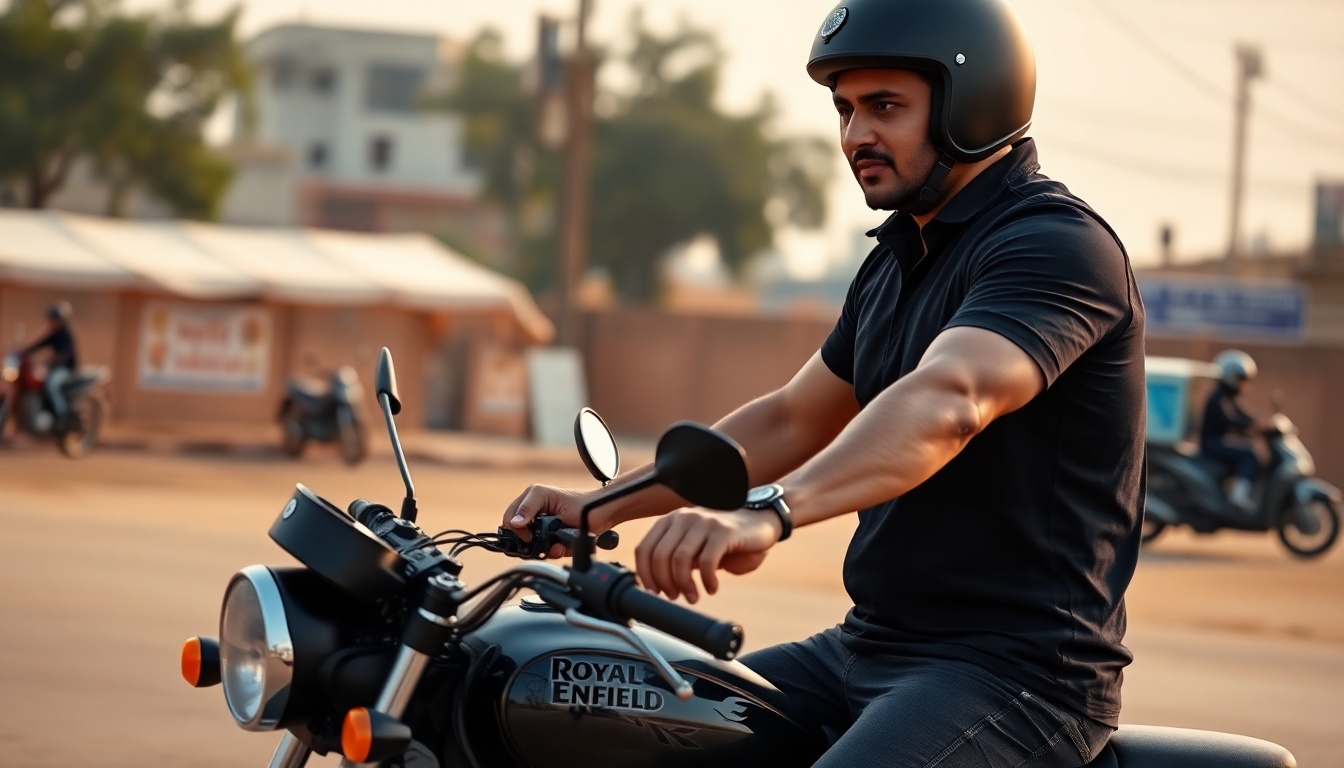
Quick Answer
A proper beginner Royal Enfield 500 course is not about learning to ride a bike. It’s about learning to manage 190 kilos of metal and torque. At Throttle Angels, our structured 3-day program focuses on low-speed control, emergency braking, and navigating real-world chaos, because that’s where you’ll need the skills. You don’t just ride the bike; you learn to command it.
I see it every weekend at our training grounds. A new rider, beaming with pride next to their shiny new Royal Enfield 500. They start the engine, that familiar thump filling the air. Then they let the clutch out, the bike lurches, and for a split second, panic flashes in their eyes.
That lurch tells me everything. It says they’ve bought into the dream but haven’t yet met the machine. The dream is open highways and mountain passes. The machine is heavy, torquey, and unforgiving if you don’t respect it. That’s the gap a proper beginner Royal Enfield 500 course exists to fill.
Look, this isn’t a scooter or a lightweight commuter. This is a different beast altogether. And the streets of Bangalore or Pune don’t care about your dream. They only respond to your control. So let’s talk about how you build that control from the ground up.
Why Most Riders Get beginner Royal Enfield 500 course Wrong
Here is what most new riders get wrong about handling a 500. They think power is the main event. It’s not. The real challenge is weight. You’re not just steering a bike; you’re balancing and redirecting 190 kilograms at walking speeds, in bumper-to-bumper traffic, on uneven roads.
I have seen this mistake cause near-accidents dozens of times. A rider stops on a slight incline at a traffic signal. They’re nervous, they give it too much throttle while releasing the clutch, and the bike either stalls violently or leaps forward towards the car in front. The real risk is not the stall. It’s the panic reaction that follows.
Another classic error is using only the front brake. On a lighter bike, you might get away with it. On a loaded Enfield, especially on a wet Bangalore road, grabbing a handful of front brake is a direct ticket to the ground. Your instinct will be to stop the heavy weight fast. Your training should be to stop it safely.
Finally, there’s the posture. People sit on it like it’s a sofa. Slouched, arms locked, feet searching for the ground. This gives you zero control. When that unexpected pothole or sudden swerve comes, you’re just a passenger. You need to be a pilot.
I remember a student, Vikram. He was a software engineer who had just bought a Classic 500. He could ride in a straight line on an empty road, but our first cone exercise—a simple figure of eight—had him sweating. The bike felt like it was fighting him, threatening to topple over at every turn.
He was trying to muscle it around with the handlebars. I made him stop. We spent an hour just walking the bike, feeling its weight pivot, then doing the exercise at a crawl using only the clutch and rear brake. The moment he learned to let the bike’s low-speed balance work for him, not against him, his entire posture changed. The fight was gone. That’s the breakthrough moment we build towards.
What Actually Works on Indian Roads
Let’s get practical. Your right hand is not just for acceleration. On our roads, it’s your primary tool for smoothness. A jerky throttle input on a 500cc single-cylinder engine gets amplified. That jerk can break traction on a dusty patch or upset your balance when filtering through traffic.
Here is the thing about the clutch. On this bike, it’s your best friend. You need to learn to live in the friction zone. Not just for starting off, but for ultra-slow control. When an auto-rickshaw cuts you off and you need to slow to a crawl without putting your feet down, the clutch and rear brake are your saviours.
Look at your feet. Are your toes just lightly on the pegs? That’s wrong. You should be able to press the balls of your feet firmly into the footpegs. This connects you to the bike. It lets you use your legs to absorb shocks and control the weight, not just your arms.
Braking is a symphony, not a single note. You need to practice progressive pressure on the front, with a firm, early application of the rear. The goal is to load the front tyre smoothly for maximum grip, while the rear stabilises the mass. Stomp on either in panic, and the bike will tell you who’s boss.
And then there’s vision. New riders stare at the bumper of the car in front. You must look where you want to go. Through the corner, past the obstacle, at the gap in the traffic. Your head leads, your body follows, and the heavy bike will come with you. It’s a subtle dance, but it’s everything.
The Royal Enfield 500 doesn’t forgive hesitation. It rewards deliberate, confident input. Your nervousness travels down your arms, into the handlebars, and the bike feels it. Calm your mind, and you’ll calm the machine.
— Throttle Angels Instructor Team
Beginner vs Trained Rider Comparison
| Aspect | What Beginners Do | What Trained Riders Do |
|---|---|---|
| Low-Speed Control | Stiff arms, stutter the throttle, fear dropping the bike. | Use the clutch friction zone and rear brake as a “speed dial” for precise, feet-up crawling. |
| Emergency Braking | Grab the front brake hard, lock up or skid, ignore the rear. | Apply progressive, firm pressure front and rear simultaneously, keeping the bike upright and stable. |
| Road Positioning | Hug the left edge, becoming invisible to traffic and hitting every drain cover. | Command a visible lane position, adjusting for best visibility and escape routes. |
| Handling Chaos | Fixate on the immediate threat (a crossing cow, a merging car). | Scan ahead for the next threat, planning a smooth path through multiple hazards. |
| Body Posture | Sit passively, arms straight, weight on the seat. | “Ride the pegs.” Core engaged, arms relaxed, using legs to manage weight and shocks. |
Adapting to Indian Road Conditions
Book Your Trial Session Today!
Ready to master the roads of Bangalore or Pune? Join India’s premier motorcycle driving school.
Training Available in Bangalore & Pune
Book Your Trial Session Today!
Ready to master the roads of Bangalore or Pune? Join India’s premier motorcycle driving school.
Training Available in Bangalore & Pune
Our monsoons are a different game. That beautiful, oil-slicked tarmac on the first rain is genuinely dangerous. On a heavy bike, your margin for error shrinks. You must smooth out every input—braking, steering, throttle. Sudden moves will break traction.
Highway riding isn’t just about holding 80 km/h. It’s about managing crosswinds that hit the Enfield’s broad tank. It’s about reading the surface ahead for patches, bumps, and those deadly undulations that can make a heavy bike feel light and unstable.
In city traffic, your biggest tool is anticipation. You must see the pedestrian about to step out, the car door about to open, the pothole hidden by a shadow. You plan your escape path before you need it. With this weight, you cannot change direction on a dime. You need a yard.
And at night? Your headlight is decent, but it’s not a laser. You must ride at a speed where you can stop within the distance you can see. That means slowing down for unlit sections. Because a stray dog, a broken-down truck, or a speed breaker appears in an instant.
Frequently Asked Questions
I already know how to ride a bike. Do I really need a special course for a Royal Enfield 500?
Absolutely. Riding a 150cc bike and commanding a 500cc Enfield are fundamentally different skills. The weight, torque, and braking dynamics require specific techniques. This course bridges that gap, translating your existing skills to a much more demanding machine.
What is the single most important skill I’ll learn in this course?
Low-speed control and balance. If you can master walking-pace manoeuvres, U-turns, and figure-eights with confidence, everything else—traffic filtering, hill starts, tight parking—becomes easy. This is where you conquer the bike’s weight.
Do I need to bring my own Royal Enfield 500 for the training?
No, we provide the training motorcycles. It’s better to learn and make mistakes on our bikes first. Once you’ve built core competency, we then help you transition those skills to your own motorcycle in a controlled environment.
How much does Throttle Angels training cost?
Our courses start at competitive rates with flexible packages. Call Rajkumar at 9535350575 or Arun at 8169080740 for current pricing and batch schedules in Bangalore and Pune.
Is this course only for complete beginners?
Not at all. We have riders who have owned Enfields for years but never learned proper techniques. They come to unlearn bad habits and build advanced skills for touring and emergency handling. There’s always a higher level of control to achieve.
Think of this not as a course, but as your foundation. That thumping engine between your legs is a source of incredible joy, but only if you’re in charge. The roads will test you. Your bike should feel like an extension of you, not an adversary.
Start with the basics. Master the clutch, respect the weight, and always look where you want to go. Build that foundation strong, and every ride that follows—every highway, every ghat, every chaotic city commute—will be safer and infinitely more rewarding. Now go make that machine yours.
Book Your Trial Session Today!
Ready to master the roads of Bangalore or Pune? Join India’s premier motorcycle driving school.
Training Available in Bangalore & Pune