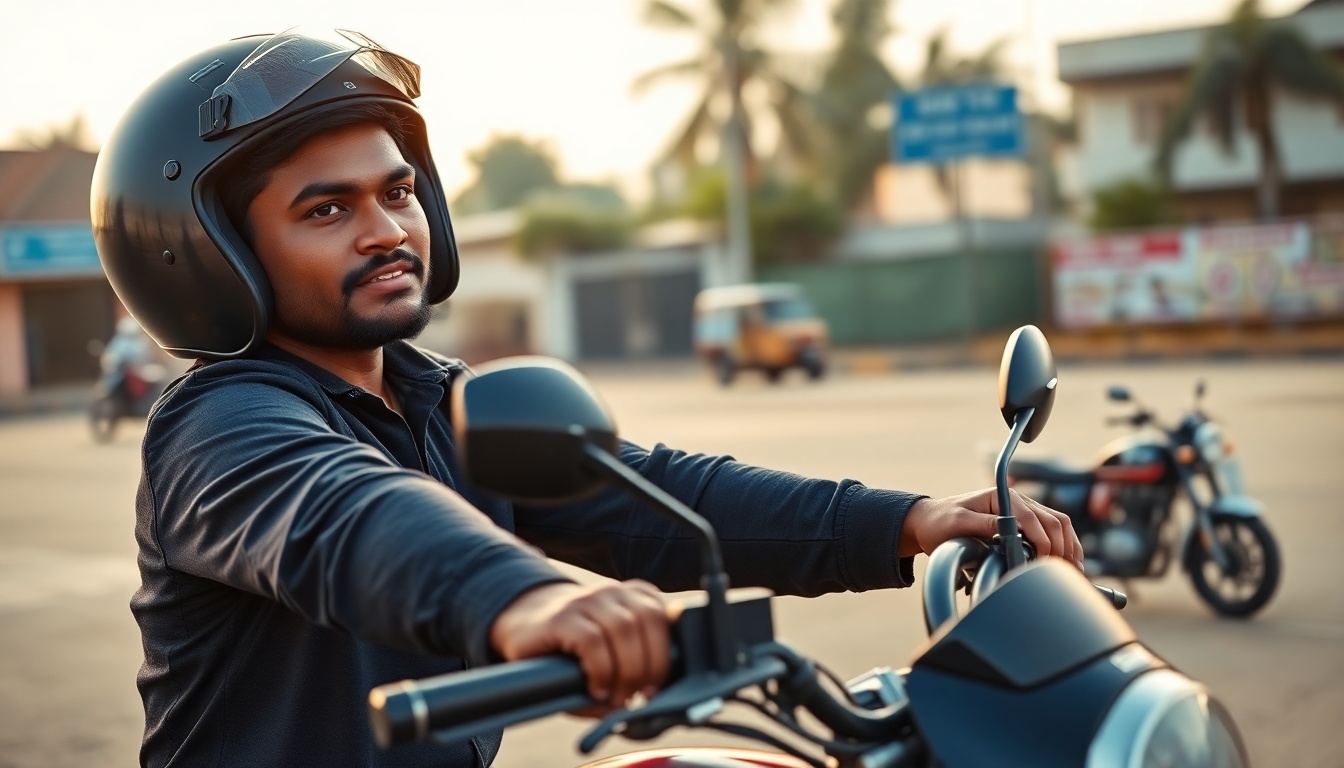
Quick Answer
Yes, you need specific motorcycle training for beginners Royal Enfield. A 350cc Bullet or Classic is not a scooter; its weight and torque demand respect. A proper 12-hour course over a weekend can teach you the clutch control, low-speed balance, and braking techniques that prevent the classic “tip-over” and build real confidence for our roads.
I see it every weekend at our training grounds. A new rider, beaming with pride next to their shiny new Royal Enfield. They start the engine, that familiar thump-thump-thump filling the air. They let the clutch out a little too fast.
The bike lurches. They panic, grab a fistful of front brake, and the 190-kilo machine starts to lean. It’s a slow, inevitable fall to the left. That first scratch on the crash guard hurts more than a bruised ego. This scene is why specific motorcycle training for beginners Royal Enfield isn’t a luxury—it’s essential.
Here is the thing about these bikes. They are not harder to ride. They are just different. That weight is a friend at 60 km/h on the highway, giving you stability. But in Bangalore’s stop-start traffic or on a steep Pune hill start, it becomes your biggest challenge. You can’t muscle it around. You have to finesse it.
Why Most Riders Get motorcycle training for beginners Royal Enfield Wrong
The biggest mistake is thinking you already know how to ride. You probably rode a friend’s bike in a colony. Or you have years of scooter experience. This confidence is dangerous.
A scooter is automatic. Your left hand and foot are free. On an Enfield, your left hand controls the clutch, your left foot shifts gears, and your right foot controls the rear brake. It’s a coordinated dance you must learn from zero. I have seen experienced scooter riders stall an Enfield a dozen times in five minutes because they forget to downshift before stopping.
The second mistake is focusing on the wrong risk. You think the risk is high-speed wobbles. It is not. The real risk is the low-speed drop. When you’re filtering through traffic at 10 km/h and a pedestrian steps out. You need to brake and keep the bike upright. That’s a skill no one is born with.
Finally, riders ignore the machine itself. They don’t know where the neutral is in that notchy gearbox. They don’t understand the long travel of the clutch. They don’t practice the “Enfield shuffle” to paddle it backwards on a slope. This isn’t about riding. It’s about handling.
Last month, a software engineer named Arjun came to our Bangalore campus. He’d just bought a Meteor 350. He told me, “Sir, I know how to ride. I just need help with the test track for my license.” I asked him to do a simple U-turn in our confined lot.
He went wide, panicked, and dumped the clutch. The bike stalled and tipped. We righted it. I said, “That’s exactly why you’re here. Not for the test track, but for the road outside.” We spent the next hour on clutch control at walking speed. By the end, he was making tight, controlled turns. His face changed. The fear was gone, replaced by focus. That’s the shift we aim for.
What Actually Works on Indian Roads
Look, theory is fine. But on our roads, you need muscle memory. The first thing we build is your relationship with the friction zone. That tiny point where the clutch engages and the bike starts to move. You must find it with your eyes closed.
We make you walk the bike, using the clutch alone, without touching the throttle. This teaches you that you can control this heavy machine with just a finger movement. It builds respect for the lever. Most riders yank it. You need to caress it.
Then comes the slow race. Who can go the slowest in a straight line without putting a foot down? This is the secret to city traffic. If you can balance at 3 km/h, you will never drop your bike. You learn to use the rear brake lightly to stabilize yourself, and a tiny bit of throttle to keep the engine from stalling.
Emergency braking is next. But not just slamming the brakes. You learn to brake straight, then turn. A cow can jump out, a car can door you. You must stop first, then swerve. We teach progressive squeeze on the front, firm pressure on the rear. And always, always, in a straight line.
Here is what most new riders get wrong about cornering. They lean their body but keep the bike upright. Or worse, they brake mid-corner. On an Enfield, you must commit. Look through the corner, press the handlebar in the direction you want to go, and let the bike follow. The weight wants to go straight. You must convince it to turn.
Finally, we talk about attention. Your eyes are your best tool. You look at a pothole, you hit it. You look at the gap next to the pothole, you go through the gap. We train your vision to scan 12 seconds ahead, not at the bumper in front of you. This gives you time to plan. On Indian roads, planning is survival.
Training on a Royal Enfield isn’t about learning to ride a motorcycle. It’s about unlearning the idea that it’s just a bigger bike. You’re learning to partner with a personality. You don’t command it; you negotiate with it. Get that partnership right, and the road opens up.
— Throttle Angels Instructor Team
Beginner vs Trained Rider Comparison
| Aspect | What Beginners Do | What Trained Riders Do |
|---|---|---|
| Low-Speed Control | Stiff arms, stuttery throttle, feet dangling. Bike feels top-heavy and unstable. | Feet on pegs, using rear brake drag and clutch friction zone. Bike is balanced and under precise control. |
| Panic Braking | Grab front brake hard, lock arms. Rear wheel lifts or skids, high chance of drop. | Progressive squeeze on front, firm pressure on rear. Body braces against tank, bike stops straight and stable. |
| Hill Start | Roll backwards, panic, stall engine. Frantic search for brake and clutch. | Right foot on rear brake, left foot down. Smooth clutch-to-throttle handoff. Moves forward without rolling an inch. |
| Traffic Filtering | Focus on handlebar clearance, clips mirrors, unstable weaving. | Focus ahead on the path, uses clutch control for speed. Bike moves in a smooth, predictable line. |
| Mental Focus | Fixed on immediate threats (that car’s bumper). Reactive riding. | Scanning 12 seconds ahead for escape routes. Proactive riding, planning moves early. |
Adapting to Indian Road Conditions
Book Your Trial Session Today!
Ready to master the roads of Bangalore or Pune? Join India’s premier motorcycle driving school.
Training Available in Bangalore & Pune
Book Your Trial Session Today!
Ready to master the roads of Bangalore or Pune? Join India’s premier motorcycle driving school.
Training Available in Bangalore & Pune
Our roads are a special kind of classroom. You have tarmac, gravel, mud, and potholes all in a 100-meter stretch. On an Enfield, you don’t swerve violently for every pothole. You learn to stand slightly on the footpegs, loosen your grip, and let the bike roll over it. Those long-travel shocks are made for this.
Monsoon riding is another beast. The first rain brings up all the oil and grime, making roads slicker than ice. Your braking distance triples. We train you to see shiny patches on the road—that’s diesel or oil. You learn to avoid manhole covers and painted road markings when wet. They are like banana peels for your tyres.
Highway touring on an Enfield is a joy. But the danger is fatigue and target fixation. That heavy bike wants to go straight, so on long, boring highways, you must consciously make small adjustments. And when a truck comes from the opposite direction, don’t stare at it. Look at your escape path on the left edge of your lane. The bike goes where you look.
At night, your biggest enemy is being unseen. That single headlamp on a classic Enfield isn’t enough. We talk about positioning in the lane to catch car headlights, using reflective gear, and never, ever assuming a driver has seen you. You ride as if you’re invisible.
Frequently Asked Questions
I have a scooter license. Do I still need training for a Royal Enfield?
Absolutely. A gearless scooter and a 350cc motorcycle are completely different machines. The license is legal permission; training gives you the actual skill to handle the weight, clutch, and power safely. Don’t confuse the two.
Is the Royal Enfield Bullet too heavy for a beginner?
It’s heavy, yes. But that’s precisely why you need training. We teach you techniques to manage that weight at low speeds. Once moving, the weight becomes stability. The problem isn’t the bike’s weight; it’s the rider’s lack of technique.
Should I buy the bike first or do training first?
Do the training first. We provide the training motorcycles. This way, you learn on a similar bike without the fear of dropping your brand-new machine. You make your beginner mistakes on our bike, not yours. Then you take delivery with confidence.
How much does Throttle Angels training cost?
Our courses start at competitive rates with flexible packages. Call Rajkumar at 9535350575 or Arun at 8169080740 for current pricing and batch schedules in Bangalore and Pune.
What if I drop the training bike?
That’s what it’s there for. Our bikes have crash guards. Dropping it is a core part of the learning process. We want you to understand the limits in a safe, controlled environment so you never do it on the road. No penalties, just lessons.
Your Royal Enfield is waiting for stories. It’s built for the long road, for the mountain pass, for the coastal highway. But those stories should start with confidence, not a scare.
Invest a weekend. Build the foundation. That thump should be the sound of your heartbeat syncing with the road, not the sound of your nerves rattling. Get the training right, and the ride will take care of itself.
Book Your Trial Session Today!
Ready to master the roads of Bangalore or Pune? Join India’s premier motorcycle driving school.
Training Available in Bangalore & Pune